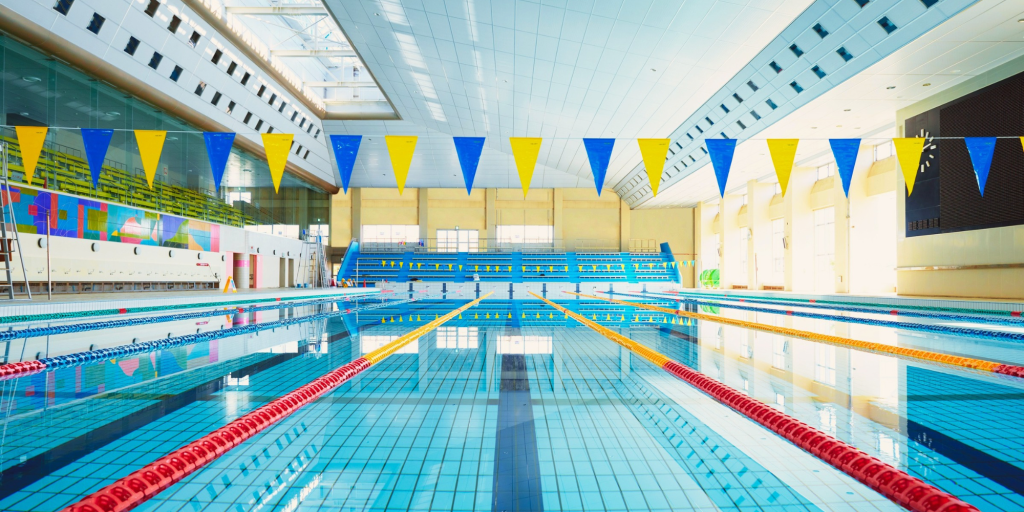
It is good to work towards transitioning confident swimmers to larger and deeper pools to progress their skills
I moved my son to a much larger swimming pool just under a year ago and since then, it has been incredible watching him progress through Swim England Stages 2 to 5, from his 5m swimming badge to 25m. In a leisure centre environment, I have really seen his confidence, self-belief and self-esteem sky-rocket. As a parent and swim teacher, I have been reflecting on why I think an eventual move to a larger pool is vital for a child’s journey through swimming.
Private, hotel and primary school pools are often warmer, shallower and smaller, perfectly designed for children in the early stages of learning to swim – they can swim short distances and often touch the floor which is great for water confidence, push and glide skills, standing from floating, plus experiencing basic water movement. Leisure centres, secondary school pools and some outdoor lidos, on the other hand, may have a ‘deep’ end and be between 25m and 50m in length – designed for longer distances and diving too. Larger pools are also often slightly cooler – once an individual is able to swim without stopping, they will stay warm through exercise and will be able to keep their body comfortable in a slightly cooler temperature.
SEND qualified and very sensory aware, I know that all children require their own optimum, personalised learning environment. I have taught in a range of small, large, quiet, busy, warm and cold pools myself and one size does not fit all! I am an advocate for individualised teaching but still think it is important that swimmers who are progressing through the levels, including those with additional needs, are given the opportunity to transition to, or at least try, longer-distance pools so that they can take advantage of the below benefits.
Going the distance
The national curriculum for swimming and water safety aims for all children to leave primary school swimming 25 metres and able to understand and perform various water safety practises.
“The minimum requirement is that, by the time they are ready to leave Key Stage 2, every child is able to swim competently, confidently and proficiently over a distance of at least 25 metres. This means demonstrating a continuous swim of more than 25 metres without touching the side of the pool or the pool floor. Whenever possible, at least part of the swim should be completed in deep water, defined as greater than shoulder depth. This is because ‘competence’ and ‘proficiency’ can’t be assured if the swim takes place in shallow water only. Using an ineffective stroke and just managing to swim 25 metres does not meet the minimum requirement.” Swim England
Personally, I think it’s more accurate to award a 25m swimming milestone badge in a 25m pool. Often if a child is working towards this distance across a smaller pool, let’s say it’s 5m, for example, they will inevitably have to hold the side every length to turn and change direction. Sometimes, not always, it is difficult to ascertain a realistic representation of how that child would actually perform across a longer distance. It can be hard to build the necessary stamina if the pool length does not reach the actual quantitative target distance. We do see evidence of this when we welcome new swimmers to larger pools – it’s one thing to swim that distance with little stops and another to do it consistently and continually without stopping.
Working towards open water
The focus of the national curriculum for swimming is very much on water safety. Child drownings in open water continue to occur each year, in the UK and across the world – it is the aim of charities such as the RLSS to reduce tragic statistics.
Step two is giving children the chance to learn water safety in actual open water settings, of course, but step one is allowing them to first acclimatise to as larger pool as possible, as its temperature and size will more accurately reflect a real open water environment.
Let’s dive!
Larger pools often have a greater maximum depth. And depth allows skills to progress and aquatic pathways to open up for the future (maybe your child will be the next Tom Daley!). As a teacher, I absolutely love teaching diving and jumping – it brings that all important element of fun that keeps kids loving coming to their swimming lessons each week.
Diving must take place in a minimum vertical water depth of 1.8m. For jumping, if you have a depth of 1.5m (or preferably more), your confident swimmers can learn a range of fun jumps – tuck, pencil, pike, rocket, star, straddle, plus the safety ‘fall in’ drill. In deeper pools, children can learn to submerge, tread water, turn around and swim back to the side – these things all become more difficult to teach if an experienced young swimmer has outgrown the pool and can now stand up. A greater depth also more accurately represents a real open water environment.
Another important aspect of the water safety curriculum is teaching children the dangers of jumping into shallow water – allowing them the opportunity to experience different depths will help them understand the difference and when to be safe.
Comfort zones
The parent is further away, the bottom is harder to see, the length is greater, the water feels a little cooler, the lights seem brighter, the noises are louder, there are more barriers to processing instruction… all of these things may be big adjustments for some children and it might take some time for them to get used to it all. That’s OK and is a perfectly normal part of learning.
If a new pool seems tricky to begin with – keep going. Within reason, being pushed slightly out of their comfort zone will build a child’s resilience, confidence and much more.
Photo: Canva