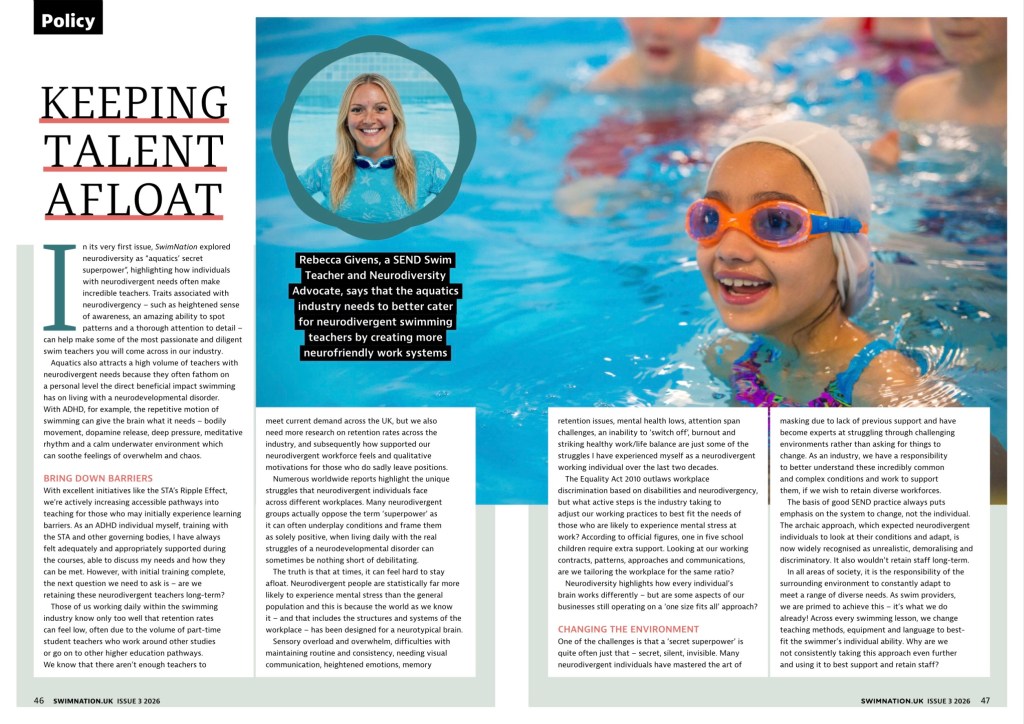
Read my article about how we can better support neurodivergent individuals in the aquatic workplace
“The real struggles of a neurodevelopmental disorder can sometimes be nothing short of debilitating. The truth is that at times, it can feel hard to stay afloat. Neurodivergent people are statistically far more likely to experience mental stress than the general population and this is because the world as we know it – and that includes the structures and systems of the workplace – has been designed for a neurotypical brain.”
In its first issue, swim industry magazine Swim Nation explored neurodiversity as “aquatics’ secret superpower” and discussed why many individuals with neurodivergent needs make incredible teachers. Articles of this nature are so important – they remind the world that neurodivergent individuals can most definitely go on to do great things.
But the term ‘superpower’ got me thinking. Whilst many of us with neurodivergent needs do feel pride in our accomplishments, it is also important that words like ‘superpower’ are juxtaposed with the less glorified reality of what are often extremely challenging lifelong conditions.
I thought it would be beneficial, therefore, for me to offer an expansion on this train of thought, and delve deep into the struggles a neurodivergent individual might experience in the workplace, plus some starting point ‘tips’ for managers and businesses wanting to implement more neurofriendly work systems.
I explore this, and more, in my new article ‘Keeping Talent Afloat’ which is in issue 3 of Swim Nation, released yesterday.
The article was also published by STA and you can read it online.
Photos: STA